
.svg)


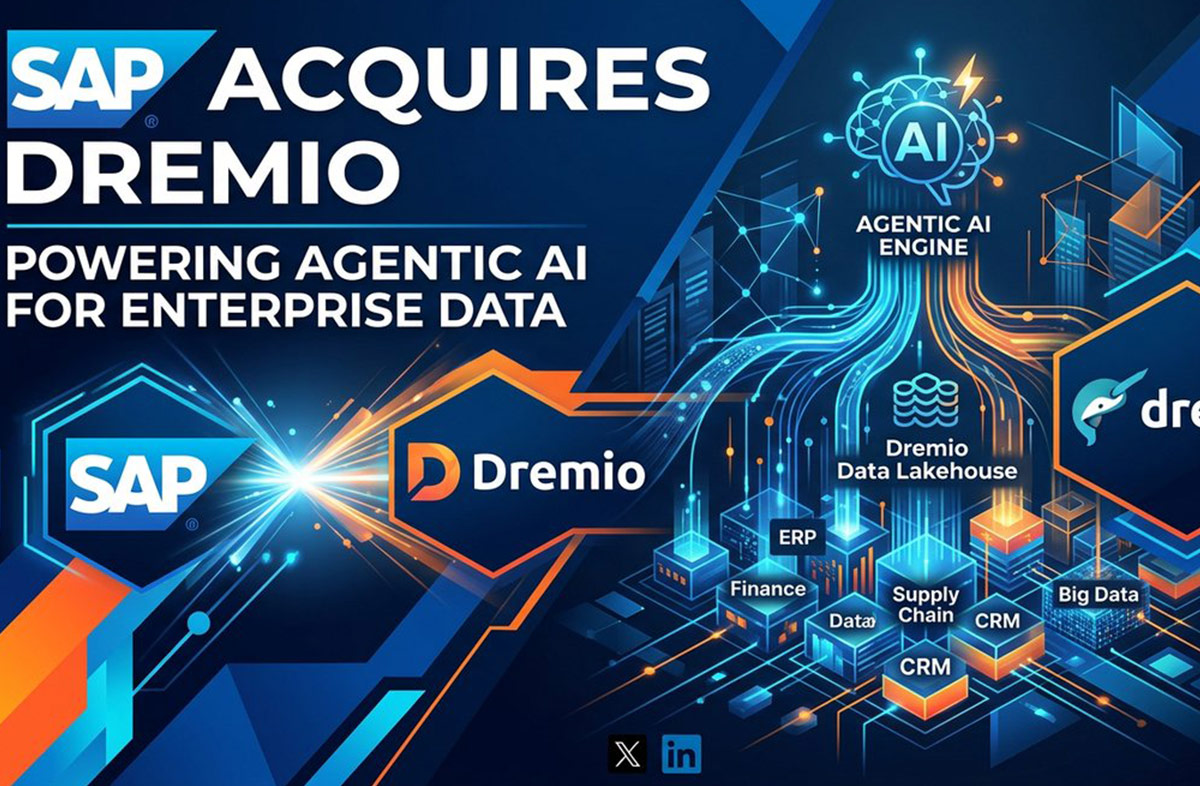
SAP’s acquisition of Dremio (https://www.dremio.com/) is a market signal, not just a transaction. When the world’s dominant enterprise software company acquires a federated data architecture business, it confirms that distributed data access has crossed from emerging technology into critical infrastructure. The more consequential question for investors is what comes next - and where the larger opportunity sits.
The Inflection Point Most Analysts Are Missing
The technology press has framed the SAP–Dremio deal as lakehouse consolidation. That misses the structural shift underneath it. Enterprise federation - connecting data across internal systems without centralising it is now table stakes. The frontier has already moved.
Small Language Models are the reason. Unlike their large-scale counterparts, SLMs are purposebuiltfor specific tasks and can run directly on device - no cloud round-trip, no centraliseddependency. Industrial equipment, autonomous vehicles, and telecommunications infrastructure arealready deploying them. The result is a fundamental change in where intelligence lives: not in a datacentre waiting for a query, but at the point of action, operating in real time.
This is not a gradual evolution. It is an architectural break. And the infrastructure required to support it - federated data access designed for intermittent connectivity, regulatory constraints, and edgenative latency - does not yet exist at scale.
The Infrastructure Gap Is the Opportunity
Enterprise data federation assumes connectivity. It assumes consolidation is possible. Edge environments break both assumptions. Data generated at the edge cannot always move to the centre - regulatory constraints, latency requirements, and cost economics all prevent it. AI systems operating at the edge need to query distributed data in governed, contextual ways, without the luxury of centralised architecture.
This gap … between what enterprise federation delivers and what edge AI deployment requires … represents one of the more clearly defined infrastructure opportunities in the current market. The demand is structural. The incumbents are not built for it. And the companies designing distributed-first architectures are ahead of a wave that SAP’s acquisition has just made visible to the mainstream.
“The infrastructure gap between enterprise federation and edge intelligence is not a product gap - it is an architectural one. Solving it requires distributed-first design from the ground up.”
Will Deane — Managing Director, Exto Partners

